


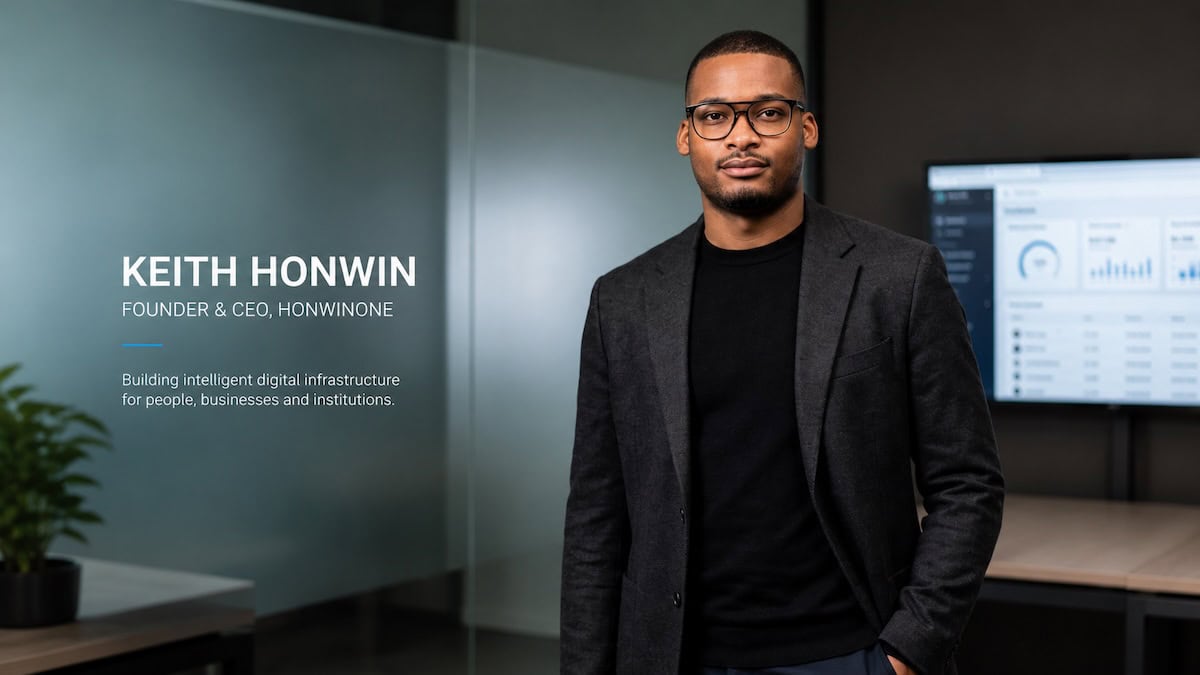
HonwinOne is building technology and infrastructure designed to connect people, businesses and institutions across markets while reducing digital fragmentation.
Keith, could you start by introducing yourself and telling us what inspired you to found HonwinOne?
I’m Keith Honwin, founder and CEO of HonwinOne. I come from Eswatini, but a significant part of my education and professional development took place in Azerbaijan, where I studied International Relations at ADA University and later worked around technology, education and innovation through organisations including Taskool and INNOLAND.
Living and working between very different environments changed the way I thought about technology.
I began to notice that many of the problems people experience are not caused by a complete absence of technology. Often, technology already exists, but it is fragmented, difficult to access, disconnected or simply not designed around the person who is supposed to use it.
A business might need several different systems just to serve one customer. A young person looking for a scholarship might search through dozens of websites, social-media pages and application portals. Someone trying to discover a nearby service, attend an event or make a payment may move between several disconnected platforms.
That stayed with me.
HonwinOne grew from a belief that technology should make life simpler, expand access and give people more possibilities—not create another layer of complexity.
I also came to understand something personally: if you genuinely want to change something, you eventually have to be willing to dream beyond borders.
That means geographical borders, industry boundaries and sometimes even the limits people place on what they believe is possible.
Eventually, I stopped waiting for somebody else to build the systems I wanted to see and decided to start building them myself.
What exactly is HonwinOne, and which core problem or opportunity is at the heart of the company?
HonwinOne is a technology company building intelligent digital infrastructure for people, businesses and institutions.
The core problem underneath almost everything we work on is fragmentation.
A customer may discover a business in one place, communicate with it somewhere else, pay through another system and receive very little visibility afterwards.
A young person looking for an international opportunity may have to search hundreds of scattered sources.
A merchant may need separate systems for orders, payments, promotions, staff management, customer communication and reporting.
These appear to be very different problems, but underneath them is the same issue: systems do not communicate well enough, and people are often forced to do work that technology should be doing for them.
Our approach is therefore not simply to ask:
“What application can we build?”
We ask:
“Where is friction being repeated across an entire system, and what infrastructure could remove it?”
That thinking has led us into local commerce and discovery through Pickly, global youth opportunity infrastructure through GYAP, payment orchestration through H1Pay, event technology, APIs and our broader work around artificial intelligence.
The long-term opportunity for HonwinOne is not simply having several products.
It is creating reusable infrastructure around discovery, identity, intelligence, transactions and action that can support many different services.
HonwinOne works across AI, commerce, local discovery, payments, event technology and youth opportunity infrastructure. How do these different areas fit together within one company and one overarching strategy?
This is one of the most important questions about HonwinOne.
From the outside, it can initially look as though we are building several unrelated products.
Internally, we see something different.
We see one infrastructure company expressed through different use cases.
Pickly deals with local discovery and demand. Someone may want to find a restaurant, discover an event, book a service, order something or interact with a nearby business.
GYAP deals with another form of discovery: opportunity. Instead of asking, “What can I find around me?”, somebody may be asking, “Which scholarship, fellowship, university, internship, grant or programme is right for me?”
Our event technology addresses ticketing, verification, access, event operations and the infrastructure surrounding physical experiences.
Our work around H1Pay addresses the transaction layer and the possibility of intelligently orchestrating payments across different systems and payment rails without requiring every HonwinOne product to become a financial institution itself.
Artificial intelligence sits across all of these as an intelligence layer.
So the connection is not the industry.
The connection is the infrastructure underneath the industries.
We are building around recurring functions:
discover, understand, identify, transact and act.
The individual products allow us to solve specific problems and reach different users.
The shared infrastructure gives HonwinOne leverage.
Over time, the objective is that improving one part of our infrastructure can strengthen several products rather than requiring us to rebuild everything independently.
Which products and technologies have you already launched, and which of them are currently the most important for HonwinOne’s growth?
Our two immediate priorities are Pickly and GYAP.
Pickly is our local discovery and commerce platform. It is designed to bring restaurants, stores, services, events, local experiences and other everyday needs into one intelligent discovery environment while giving merchants tools to establish and manage their digital presence.
Rather than forcing people to already know exactly where to search, Pickly is designed around discovery: helping somebody understand what is available, what is happening around them and what they can do next.
GYAP—the Global Youth Aspiration Platform—is focused on opportunity discovery.
It brings together scholarships, fellowships, internships, grants, training programmes, education pathways and other opportunities that are often scattered across the internet.
GYAP is particularly meaningful to me because education, youth development and international exposure have been an important part of my own journey.
Both Pickly and GYAP are publicly accessible and are now entering the most important stage for us: market activation, distribution and real-world adoption.
We have also developed significant technology around H1Pay and our event systems.
However, I think founders have a responsibility to distinguish between technology that has been built and infrastructure that has completed every commercial, regulatory and partner integration required for full-scale operation.
H1Pay, for example, remains in the integration and partnership stage rather than something we would describe today as a fully connected payment network.
One of our biggest lessons has been that having the ability to build many things does not mean we should try to scale everything simultaneously.
Our priority now is turning technology into sustained usage.
You are building HonwinOne from Eswatini with the ambition to serve global markets. What advantages and challenges come with building a technology company from a relatively small and underrepresented startup ecosystem?
Building from Eswatini gives you a very interesting kind of discipline.
In a smaller market, problems are close to you.
You can see how businesses actually operate. You see where people improvise because a system does not work properly. And you see where digital services are too complicated, too expensive or simply unavailable.
That proximity can be a major advantage because you are not solving theoretical problems.
You are surrounded by the consequences of systems that do not work well enough.
It also forces resourcefulness.
You cannot assume that unlimited capital, specialised talent or infrastructure will always be available. You have to find ways to build efficiently, reuse systems, automate repetitive work and make each decision count.
The challenges are equally real.
Founders from smaller and less represented ecosystems often have to prove two things simultaneously.
First:
Does the technology work?
And second:
Can a serious global technology company really come from this place?
Access to venture capital is more limited. Specialised technical talent can be harder to find. Certain APIs, payment systems and integrations that startups in larger ecosystems may take for granted can require considerably more work.
But I do not see Eswatini as something HonwinOne has to overcome.
I see it as part of our perspective and potentially part of our advantage.
If you can build technology that is simple, resilient and useful under real constraints, many of those lessons can travel.
And sometimes being underestimated gives you the freedom to think differently.
Many startups in emerging ecosystems initially focus on solving problems within their domestic markets. Why did you decide to think internationally from the beginning?
Partly because my own life taught me to think internationally.
I grew up in Eswatini, studied in Azerbaijan and have worked with people and organisations across different countries and cultures.
Once you experience different parts of the world closely, borders begin to look different.
You realise that people living thousands of kilometres apart can experience remarkably similar problems.
A small business in Eswatini struggling with digital discovery may have something in common with a small business in Mozambique, Azerbaijan or another emerging market.
A student in Southern Africa searching for an international scholarship may experience many of the same frustrations as a student in Central Asia or somewhere else in the world.
The interface may change.
The language may change.
The payment method may change.
The regulation may change.
But many of the underlying problems are universal.
That is why I never wanted Eswatini to become the ceiling of HonwinOne’s ambition.
It can be an excellent place for us to learn, build, test and prove things.
But the architecture has to be capable of travelling.
At the same time, international ambition cannot mean blindly copying exactly the same product into every market.
Countries have different languages, cultures, regulations, payment behaviours and commercial structures.
The challenge is to build technology that can localise without losing its core.
I have come to believe that meaningful change requires us to dream beyond borders and to work with people who do not necessarily come from the same place we do.
The biggest problems do not respect borders, so our thinking should not be limited by them either.
Artificial intelligence is a central part of your work. How are you currently using AI within HonwinOne, and where do you see the greatest potential for AI across your products and infrastructure?
I believe artificial intelligence becomes most valuable when it stops feeling like a separate feature and starts quietly improving how an entire system works.
Within HonwinOne, we are applying AI in areas including discovery, matching, information organisation, business onboarding, personalisation and decision support.
A merchant should not need to understand complicated software just to establish a useful digital presence.
A young person should not have to manually search hundreds of opportunities to find the few that are genuinely relevant to their goals.
A customer should not eventually have to navigate exactly the same generic interface every time if the system can, with appropriate consent, understand their context and what they are trying to accomplish.
However, I am also careful about calling every automated process “AI”.
The longer-term thesis for us is much more ambitious.
Most software today still waits for the user to tell it almost everything.
You open an application, navigate menus, repeat information and constantly instruct the system.
We believe software will increasingly become adaptive.
It should understand where somebody left off, what they usually need, what they are trying to achieve and what the most useful next action may be.
That does not mean removing human choice.
It means removing unnecessary friction.
Our long-term thinking is toward increasingly personalised digital intelligence—systems that become more useful because they learn from context, history and user preferences, while keeping the user in control of that relationship.
For us, therefore, the future of AI is not simply putting another chatbot inside every product.
It is building adaptive digital infrastructure that progressively becomes more useful to the person using it.
You mention building multiple products with limited resources. How have these constraints influenced the way you develop products, set priorities and make decisions as a founder?
Constraints have shaped HonwinOne profoundly.
When resources are limited, you cannot solve every problem by hiring another department.
You have to think architecturally.
You ask whether something can be reused.
And you automate repetitive work.
You create shared components.
You become extremely conscious of where time and money are going.
It has also kept me very close to the products.
I spend a significant amount of time testing flows myself, looking for things that break, questioning assumptions and asking where we are creating unnecessary friction for users.
AI-assisted development has dramatically changed what small teams are capable of building.
A very small team can now experiment, design, test and develop at a speed that would have required considerably more resources only a few years ago.
But that creates another danger.
Software can sometimes be produced faster than it can be properly validated.
So testing becomes even more important.
One of the biggest things I have learned is that speed and quality should not be treated as opposites.
The objective is to create a development system where you can move quickly, test aggressively, learn from reality and continuously improve.
Constraints have also forced us to become more disciplined about priorities.
We have built a lot.
The next chapter is not about proving that we can build another product.
It is about proving that we can take the strongest products we already have and create meaningful, repeatable adoption around them.
What is the business model behind HonwinOne, and how do you plan to build a sustainable and scalable company across different products and markets?
The commercial model varies by product, but the broader HonwinOne strategy is to create recurring infrastructure and platform revenue rather than depending on a single source of income.
For Pickly, the business side of the network creates several potential revenue streams, including merchant services, subscriptions, transaction-related revenue, promotions and value-added operational tools.
For GYAP, the commercial opportunity is primarily institutional.
Universities, education providers, foundations, NGOs and other organisations can use the platform for opportunity distribution, recruitment, programmes, profiles and related infrastructure.
Our payment work is designed around orchestration and APIs rather than the assumption that HonwinOne itself must become a bank.
As the appropriate commercial and regulatory integrations mature, that can create infrastructure and usage-based revenue.
Our event systems create additional B2B opportunities around ticketing, access infrastructure, verification, cashless experiences and event operations.
At the HonwinOne level, there is another important layer.
We can license technology, APIs and specialised digital infrastructure to companies, institutions and governments rather than requiring every organisation to build the same underlying capabilities from the beginning.
So the broader opportunity is a combination of consumer distribution, business software, transactions, licensing and infrastructure.
However, at our current stage, I believe there is something more important than trying to monetise every possible feature.
We first need to prove repeatable usage and measurable value.
If people genuinely choose the products, businesses receive measurable outcomes and institutions can achieve better results through the infrastructure, sustainable monetisation becomes much easier to build.
What stage is HonwinOne currently at in terms of users, customers, partnerships and traction, and which milestones have been particularly important so far?
We are still an early-stage company, and I prefer to be transparent about that.
We do not yet have the enormous user, GMV or revenue figures that later-stage technology companies can point to, and I would rather build those numbers than manufacture a story around them.
Our most important milestone so far is simpler:
We moved beyond ideas and presentations into working products.
Pickly is publicly accessible and includes the foundations for consumer discovery, merchant onboarding and digital commerce.
GYAP is also publicly accessible and is evolving into a technology platform for global opportunity access.
Alongside these products, we have developed payment, ticketing, AI and API capabilities.
We are now actively pursuing merchants, institutions, businesses, ecosystem organisations and public-sector relationships across different markets.
That is the stage HonwinOne is entering now:
commercial validation and distribution.
The milestones that matter next are very clear:
active merchants, active users, repeat usage, transactions, institutional customers, strong partnerships and evidence that our products are becoming part of people’s normal behaviour.
We are also entering HonwinOne’s pre-seed chapter because the bottleneck has changed.
Earlier, the biggest question was:
Can we actually build?
We have answered a significant part of that question.
The next question is:
What happens when that ability to build is matched with the capital, team, partnerships and distribution required to scale it?
That is the chapter we are now working toward.
From your perspective, what needs to change for more technology companies from African and other emerging startup ecosystems to compete successfully on a global level?
The first thing is access to serious risk capital.
There are many competitions, programmes, incubators and small grants across emerging ecosystems, and they can be valuable.
But companies with global ambitions eventually need investors who are prepared to finance uncertainty.
Technology companies are built around things that have not been proven yet.
Someone has to be willing to take that risk alongside the founder.
The second issue is access to markets.
Governments and large corporations regularly speak about supporting innovation, but startups need procurement systems that allow young companies to become actual suppliers—not only participants in conferences, competitions or innovation programmes.
Third is global connectivity.
Talent, investors, technical partners, mentors and distribution are not evenly spread around the world.
A founder’s access to the right network can sometimes matter almost as much as the quality of the technology.
But I also think something needs to change in the way founders from emerging markets see ourselves.
We should not believe that every African technology company must remain an “Africa-only” company.
We should solve local problems deeply.
And we should understand our environments better than anybody else.
But we should build to global standards.
Innovation does not have a nationality.
A technology company should ultimately be evaluated on whether its technology works, whether people need it, whether its economics make sense and whether its team can execute.
The next important global technology company does not necessarily have to come from the place everybody is currently watching.
It can come from somewhere unexpected.
And creating more pathways for those unexpected companies to access capital, markets and global networks will benefit everyone.
Where do you want HonwinOne to be in the next three to five years, and what is your long-term vision for the company?
In three to five years, I would rather have two or three HonwinOne products creating genuine value at meaningful scale than twenty impressive demonstrations.
I want Pickly operating across multiple markets with strong local merchant and consumer networks.
I want GYAP to become genuine infrastructure connecting young people with universities, institutions, programmes and opportunities across borders.
And I want our payment and API infrastructure integrated wherever the appropriate commercial and regulatory partnerships exist.
I want businesses, governments and institutions to be able to use HonwinOne infrastructure rather than rebuilding the same underlying systems from the beginning.
And across all of those products, I expect artificial intelligence to become less visible but considerably more important.
It should quietly improve discovery, personalisation, decision-making and how people interact with technology.
But my long-term vision goes beyond products.
During this journey, I came to understand that if we genuinely want to help change the world, we have to be willing to dream beyond borders and work together across them.
No individual founder, company or country solves the world’s biggest problems alone.
And I am very aware of the odds.
Startups fail.
Technology changes quickly.
Markets can reject you.
Capital can disappear.
Things can go wrong.
There are thousands of reasons why an ambitious idea may never become what its founder imagined.
But I think there is something worth pursuing even in the smallest probability.
Even if there were only a 0.0001% chance that something we build could eventually improve the lives of millions of people, create opportunities for people who previously did not have them, help a small business grow, or allow somebody to access something they once believed was beyond their reach, I believe that possibility is worth working toward.
That is the kind of company I want HonwinOne to become.
A company built from Eswatini, working across borders, collaborating with people from different parts of the world and using technology to expand what is possible for others.
I also want a young person from a small country or an overlooked community to see HonwinOne one day and realise that where you begin does not have to determine where your ideas can go.
We are under no illusion that what we are trying to accomplish is easy.
The odds of failure are real.
In many ways, we are trying to prove something that can sometimes feel impossible.
But perhaps that is precisely why it is worth attempting.
We are here to build useful technology, help people, work with others and pursue that tiny possibility that something we create can leave the world better than we found it.
We are here to try to prove the impossible.
And if HonwinOne can help demonstrate that meaningful technology can be built from anywhere, that people from different countries can build together, and that even the smallest starting point does not have to define the size of an ambition, then this journey will have meant something far beyond the company itself.
Picture credit: Eddie Honwin / Private
Thank you Keith Honwin for the Interview
Statements of the author and the interviewee do not necessarily represent the editors and the publisher opinion again.