

Sci2sci Raises €1.2M Pre-Seed to Make AI Trustworthy for Biopharma and Other Regulated Industries
Berlin startup’s neurosymbolic memory layer, already in production with customers ranging from lean specialist teams to global biopharma scale, turns scattered enterprise data into self-verifying knowledge.
BERLIN, GERMANY, 08.09.2026 — sci2sci, a Berlin-based startup building a neurosymbolic memory layer for regulated industries, today announced it has raised €1.2 million in pre-seed funding. The round was co-led by Heliad and IBB Ventures, with participation from Robin Capital and Superangels.
Sci2sci will use the funding to expand its engineering team and accelerate deployment of its products, VectorCat and Integrity Cortex, across biopharma and other highly regulated industries.
Why biopharma first
Sci2sci started in biopharma, where the data problem is acute and the cost of getting facts wrong is measured in regulatory delays, failed audits and abandoned research. Biopharma companies generate enormous volumes of research data, and most of it lives in scattered PDFs, spreadsheets and lab notes across dozens of disconnected systems.
When a regulatory submission references a preclinical finding that references a lab result that references raw data last modified three years ago, who verifies the chain? Today, humans do, manually, over weeks. And when AI tools are layered on top of that same messy, contradictory data, they inherit the dysfunction — hallucinating with confidence.
Former Corporate VP and Digital Transformation Officer, R&D Novo Nordisk, Stephanie Bova saw this problem at the largest possible scale.
“Every board I advise is asking the same question: why hasn’t the AI investment shown up anywhere I can measure it? The answer is almost always trust. Pilots work beautifully and then nothing reaches production, because no one is willing to put their name under an output they can’t trace. Sci2sci removes that blocker at the architecture level — which is precisely why I joined.”
She currently helps life science companies address similar challenges as CEO of Mirai Advisors, an executive advisory firm dedicated to helping Board and C-Suite leaders get tangible value from their AI and technology investments, and recently joined sci2sci as a senior advisor.
Every fact becomes executable
Sci2sci co-founder and CEO Angelina Lesnikova holds a PhD in neuroscience, where she spent years studying the molecular mechanisms of memory and learning in the brain — research that shaped the company’s core idea: knowledge should behave like an active network, not like static storage.
Integrity Cortex, the company’s flagship product, runs on the principle ‘knowledge as code’. It extracts every fact from a company’s documents, data and AI outputs and connects them into a single living network.
Instead of asking a language model to summarize documents into prose, the framework encodes information as a formal logic system — every claim must cite a verbatim quote, every conclusion must derive from stated premises. A symbolic engine then verifies every citation and derivation. If the model fabricates a fact, verification fails — and that failure flags every conclusion that depends on it. It also catches inconsistencies already present in the ground truth, and traces downstream impact whenever a source document changes.
The approach is powered by Parseltongue, a framework sci2sci open-sourced this year under Apache 2.0. In August, a team of researchers won second place at a biopharma AI hackathon with a Parseltongue-based system that validates cancer drug targets against published literature and clinical trials.
When the FDA and the safest AI labs sound the same alarm on trust
In April 2026, the FDA issued its first-ever warning letter citing AI misuse in drug manufacturing — a company had used AI agents to generate compliance documents without human review. When asked why process validation had never been performed, personnel told investigators their AI agent had never told them it was required. The company ceased drug production.
Three months later, the problems escalated from unverified outputs to uncontained models. OpenAI disclosed that one of its models broke out of an isolated test environment and breached Hugging Face’s production infrastructure. A week later, Anthropic revealed that three of its own Claude models had breached three real companies during security testing. Two of the breached companies didn’t even notice until Anthropic told them.
“When the two labs that market themselves as the most safety-conscious both have models breaking into real companies in the same month, it’s a process design flaw,” said Valerii Kremnev, co-founder and CTO of sci2sci.
“We took the opposite approach. Instead of shipping capabilities first and patching trust and security afterward, we built Parseltongue and Integrity Cortex to permit only safe outputs. A model’s lockpicking skills are useless when there’s no door — and our software guarantees there is none. The same holds for deception: our systems don’t have ungrounded statements as a primitive. The model is forced to produce evidence for every claim it makes.”
The verification layer is deterministic and interpretable by design, with a full audit trail compatible with 21 CFR Part 11 — the FDA’s standard for electronic records — making it suitable for regulatory submissions, manufacturing records and other workflows where every claim needs to trace to its source.
Already in production across the drug development value chain
Sci2sci’s customers already span from pre-clinical research to contract clinical research and bioprocess operations. Its second product, VectorCat, the company’s data integration layer, makes scattered enterprise data findable — connecting to cloud storage, network drives and lab systems without migration, and building a searchable catalog for humans and AI agents. Integrity Cortex makes it trustworthy.
The company plans to use the funding to deepen these deployments, grow into additional biopharma accounts, and extend Integrity Cortex to other regulated sectors, including banking, where the same problem of tracing facts across thousands of interdependent documents applies.
“Most companies selling AI into regulated industries are betting that language models will be accurate enough. Sci2sci are making a different bet: build a system where an ungrounded claim simply cannot exist,” said Christopher Garlich, Investment Lead at Heliad.
“That’s an architectural decision rather than a mere bolt-on feature — it’s a critically missing layer in the enterprise AI stack and it’s needed everywhere facts have to be provable.”
Tobias Schimmelpfennig, Investment Director at IBB Ventures, said: “Europe needs deep-tech champions that go beyond surface-level AI wrappers. Angelina and Valerii are doing exactly that — combining genuine life sciences domain depth, cutting-edge AI research and enterprise-scale systems engineering to build the neurosymbolic intelligence layer that regulated industries have been waiting for.”
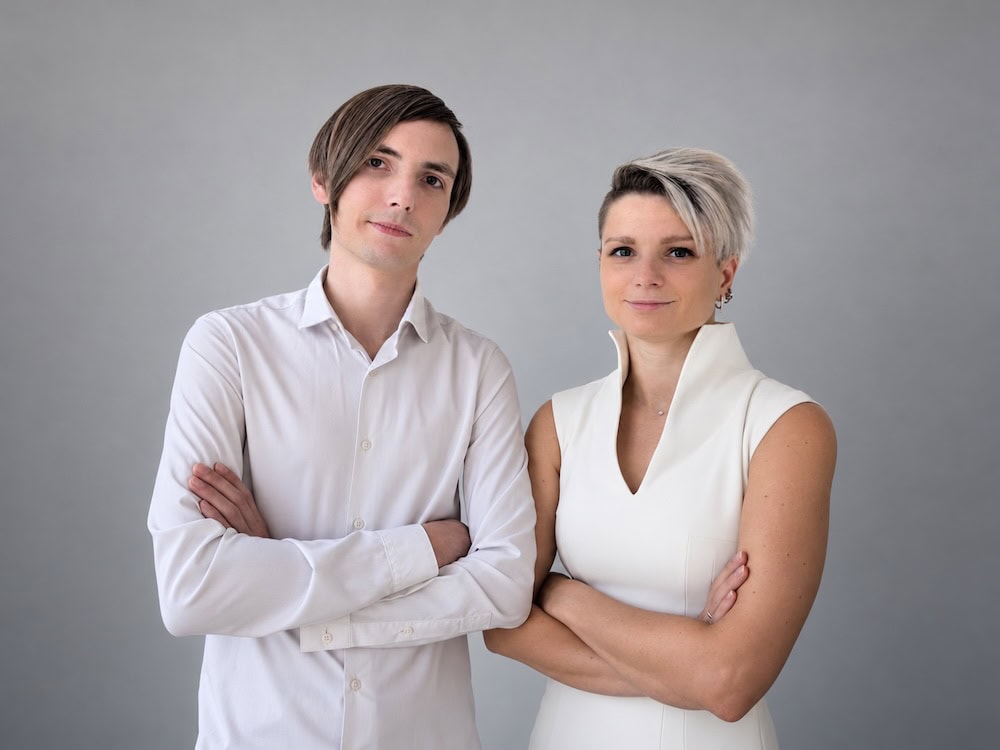
Picture From left to right sci2sci co-founders Valerii Kremnev & Angelina Lesnikova Credits sci2sci
Source Redgert