


Whitespace develops AI and technology for organisations that need secure, resilient and trusted solutions in complex operational environments.
Could you briefly introduce Whitespace and tell us how the company was founded?
I co-founded Whitespace in Belfast in 2015. From the beginning, the ambition was to build technology that could solve difficult, real-world problems rather than technology for technology’s sake.
Today, Whitespace is a British sovereign AI company helping organisations operationalise trusted AI in complex and highly regulated environments. We’ve built much of our credibility in defence and government, where resilience, security and control really matter, and we’re now taking that capability into a much broader global market.
You founded Whitespace around a decade ago. How has the company evolved since then?
We’ve evolved enormously. Whitespace started by building digital products and solving complex workflow problems, which gave us a strong foundation in understanding how organisations actually adopt and use technology.
Over time, particularly through our work in defence and government, we saw a much bigger opportunity emerging around AI. That led to Collective, our AI operating system, which provides the environment through which organisations can use AI securely and build and deploy operational AI applications.
The company has evolved with the technology, but the principle has remained remarkably consistent: start with the operational problem and build technology around the outcome.
What is the vision behind Whitespace, and what role does sovereign AI play in it?
We believe AI is approaching an important inflexion point. The last few years have been about AI learning from historical data, and it has learnt so well it can now generate credible new content, whether text, images, audio, video or code. However, AI that has learnt about the past is very different from AI that can help you decide the future. This is the real inflexion point that we are leading on – AI becoming operational, helping organisations understand situations, make decisions, act, learn from what happens in real time and adapt.
Our vision for Whitespace is to help organisations make that transition. Those that can make trusted decisions faster, continuously learn and adapt will have an enormous advantage. We call that Decision Superiority, and it is fundamental to operational resilience.
Sovereignty is an important enabler of that resilience, but I don’t define sovereignty simply by where a company or model was developed. It comes down to control, choice and resilience: control over your data and technology, the freedom to choose and change suppliers or models, and the ability to continue operating when circumstances change.
Ultimately, we’re building for a world where AI isn’t simply something organisations ask questions of, but something they can trust as part of how they operate.
Whitespace already works with organisations such as the Royal Navy and the British Army. What are their key requirements when it comes to AI?
Defence organisations don’t lack interest in AI. The challenge is turning AI into something they can trust and use operationally.
That means security, governance, audibility and control are essential, but so is resilience. Technology may need to operate across cloud, on-premises, edge and disconnected environments, often with highly sensitive information.
That’s what we’ve designed Collective around. It allows organisations to bring together different models, data, knowledge and AI capabilities within a governed environment, rather than becoming dependent on a single model or supplier.
The technology has to work around the operational environment, not the other way around.
What sets Whitespace apart from other companies developing AI solutions?
We’ve spent a decade building credibility in some of the most demanding operational environments in defence and government. Impressive AI technology means very little if organisations don’t trust you to deploy it against real problems.
Our approach is also different. We start with the decision or operational challenge, rather than a model or dataset looking for a use case. Through Collective and our team, we work alongside customers to build capabilities around those problems.
Collective is designed around resilience and choice, allowing organisations to use different models and technologies without becoming locked into a single provider. And importantly, we build learning into the process – helping organisations decide, act, learn and adapt.
Ultimately, we combine technology, operational experience and proximity to the customer. We’re building AI alongside organisations that need it to work in the real world.
Sovereign AI has become an important topic for governments. What does technological sovereignty mean to you in practice?
Sovereign AI is becoming a widely used term, and I think we need to be careful about what it actually means. A company being British, or technology being built in the UK, does not automatically make the capability sovereign.
For me, sovereignty comes down to control, choice and resilience. Who controls your data and technology? Can you choose where it runs and change models or suppliers? And can you continue operating if access to a provider changes?
That doesn’t mean everything needs to be built domestically. Organisations should be able to use the best technology available without becoming dependent on any single component or supplier.
Sovereignty isn’t isolation, and it isn’t simply a label based on where something was built. It’s having the control and choice to keep operating when circumstances change.
Defence is a highly demanding environment for technology. What have been the biggest challenges for Whitespace so far?
Ironically, the technology often isn’t the hardest part. One of the biggest challenges is getting innovative technology through the processes required to put it into operational use.
Defence understandably has extremely high standards around security, assurance and risk, but procurement processes weren’t designed for the pace at which AI is developing. Smaller technology companies can sometimes prove a capability quickly and then spend considerably longer navigating the route to deployment.
I don’t think the answer is lowering standards – particularly in defence. It’s creating procurement and adoption models that maintain those standards while allowing genuinely capable technology to move much faster from experimentation into operational use.
You have successfully exited two companies and invested in more than 100 tech businesses. How has that experience shaped the way you lead Whitespace?
It’s taught me that technology companies succeed by solving problems people genuinely care about.
I’ve seen incredibly sophisticated technologies struggle because they were looking for a problem, and comparatively simple ideas become enormous businesses because they solved something important.
That’s shaped how we’ve built Whitespace. We spend a lot of time close to customers and the environments in which our technology will actually be used. It’s also taught me not to become too attached to a particular technology or business model. Markets change incredibly quickly, particularly in AI, and founders need to be willing to learn and adapt with them.
How do you see the role of AI in defence evolving over the next few years?
We’re going to see AI move much further into operational environments. The focus will shift from isolated experiments and individual use cases towards trusted, auditable systems that can support people operating in complex and high-pressure situations.
That will make resilience increasingly important. Defence organisations will need AI that can operate securely across different environments, continue functioning when connectivity is constrained, and give users confidence in how outputs and decisions are reached.
The technology is moving quickly enough to make this possible. The challenge now is ensuring procurement, infrastructure and adoption can move quickly enough with it.
What are the next steps for Whitespace, and where do you see the company in the future?
We raised an oversubscribed $13 million Series A last year and are now preparing for our Series B funding round as we enter the next stage of Whitespace’s growth.
We’ve scaled significantly over the past year, and our ambition is to grow the team by a further 50% as we scale Collective, deepen our work across defence and government, and expand our presence internationally, particularly across the US and EU.
Defence has given us an extraordinary environment in which to build and prove our technology, but the challenges we’re solving – operational resilience, complex decision-making, organisational knowledge and control over AI – exist across many industries and markets.
We’re building a global AI company from Belfast, and the next phase is about taking what we’ve proven in some of the world’s most demanding environments and scaling it internationally.
Finally, what three pieces of advice would you give to other founders building technology companies today?
First, spend more time talking to customers than talking to investors. Funding is important, but ultimately customers build companies.
Second, solve a real problem. Don’t start with a technology and then try to manufacture a use case around it.
Third, be prepared to adapt. Whitespace today looks very different from the company we founded in 2015. The ambition hasn’t changed, but the technology, market and opportunity have. Knowing what shouldn’t change – and what absolutely should – is an important part of building a company.
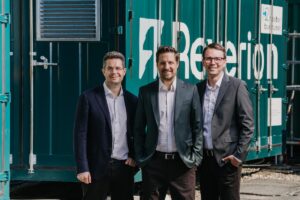
Picturecredits Whitespace
Thank you Paul Jenkinson for the Interview
Statements of the author and the interviewee do not necessarily represent the editors and the publisher opinion again.