


YourPoste is an international C2C marketplace that connects customers and travellers through a digital platform for cross-border shipping and purchase requests.
Mohamed, could you briefly introduce yourself and YourPoste and explain how your personal experience as a Moroccan living in Spain led to the idea of building an international marketplace?
I am Mohamed Arhoujdam, founder and CEO of YourPoste. I came to Spain in 2014 through Erasmus and later moved to Valencia. After that, I worked for several years in IT for international companies. Anyone who lives abroad and has family or friends in another country knows the question: “Do you know someone travelling there soon who could take something with them?” YourPoste was born from that recurring everyday problem. We wanted to turn an informal practice into a digital, structured and more trustworthy platform.
What exactly is YourPoste, how does the matching between customers and travellers work, and what problems are you trying to solve with your business model?
YourPoste is a cross-border C2C marketplace. Users publish a shipping or purchase request, and travellers who are already taking the same route can make a paid offer. The platform facilitates matching, digital communication, payment and transaction traceability. We mainly address three problems: expensive or inflexible cross-border shipping, difficulty accessing certain products from another country, and the uncertainty of informal arrangements made through personal contacts or social networks.
The idea is based on travellers carrying small shipments or completing purchase requests on routes they were already planning to take. How does a typical transaction work, from publishing a request to successful delivery?
The customer first publishes the route, item and relevant conditions. Travellers with a compatible trip can see the request and submit an offer with the reward they expect. Once an offer is accepted and paid, both sides can coordinate the necessary details. The traveller collects the item, or completes the agreed purchase in a Buy & Bring transaction. Delivery is then confirmed using a one-time OTP code. This creates a digital record from the original request through the offer and final handover.
YourPoste connects two different user groups that depend on each other. How did you begin building this two-sided marketplace, and what challenges arise when supply and demand need to grow at the same time?
This is one of the main challenges of our business model. A request only has value if there is a suitable traveller on the same route, while travellers only find the platform useful if there are enough relevant requests. That is why we do not look at the marketplace only globally; we analyse it corridor by corridor. As of 23 November 2026, 2,439 SHIP requests and 2,094 trips had been published, and we have more than 5,000 users overall. Our main next step is to create enough traveller density on our strongest routes so users receive their first offer much faster.
Trust is a decisive factor in your business model because the parties often do not know each other. What safety mechanisms have you developed to protect customers and travellers and reduce fraud?
Trust is part of the product, not just a support function. Users can verify their identity and receive a visible verification status. Requests, trips, offers, messages and deal statuses are recorded digitally. Contact details are not simply exposed before payment, which helps reduce off-platform circumvention and uncontrolled arrangements. Successful delivery is confirmed through an OTP code. We also use reviews and clear safety rules, and we are currently working on an optional insurance solution for eligible shipments.
International transport involves different customs rules, import restrictions and legal requirements. How do you make sure that only permitted items are transported through YourPoste and that both sides understand their responsibilities?
YourPoste is an intermediary and does not replace customs or import rules. We define prohibited and restricted categories, inform users about their responsibilities and provide guidance on customs and import requirements. Travellers are expected to physically inspect the item before accepting it and should only carry items they are comfortable with and that are permitted on the relevant route. If there is uncertainty, a traveller can refuse or cancel the transaction. As we develop individual corridors further, we can also make the country-specific guidance increasingly precise.
YourPoste originally focused on the needs of Moroccan users. You now also reach users from Latin America and different European countries. How has your target audience evolved, and what have you learned from international expansion?
The original starting point was indeed the experience of Moroccan communities in Europe. Very quickly, however, we saw that the underlying problem was not tied to one nationality. People from Algeria, Tunisia, Latin America and other European countries face similar needs. The main lesson is that we are not building a product “for Moroccans”; we are building a platform for people who live, travel, shop and maintain personal ties across borders. The problem is international, even though each route has its own habits, prices and regulatory requirements.
Europe–North Africa and Europe–Latin America are particularly important regions for YourPoste. Why are these markets attractive, and what differences do you see in user behaviour?
These regions have large international communities, frequent travel flows and strong personal connections between countries of origin and residence. Europe–North Africa already shows clear demand, particularly on routes such as France–Morocco and Spain–Morocco. Europe–Latin America is different geographically: journeys are less frequent and longer, but certain purchase and carry requests may have higher value. For us, the key is not to open too many countries at once, but to build density where demand and traveller flows overlap.
YourPoste facilitates paid transport and purchase requests. How is your business model structured, how is traveller compensation agreed, and how does the platform earn revenue?
Traveller compensation is agreed through offers between users. YourPoste earns money only when a transaction takes place. In our current configuration, we charge a 10% platform fee on the traveller reward, a 3% traveller-side fee, and for Buy & Bring an additional 2.5% fee on the item value. This means our revenue is directly linked to successful deals rather than simply publishing a request or trip.
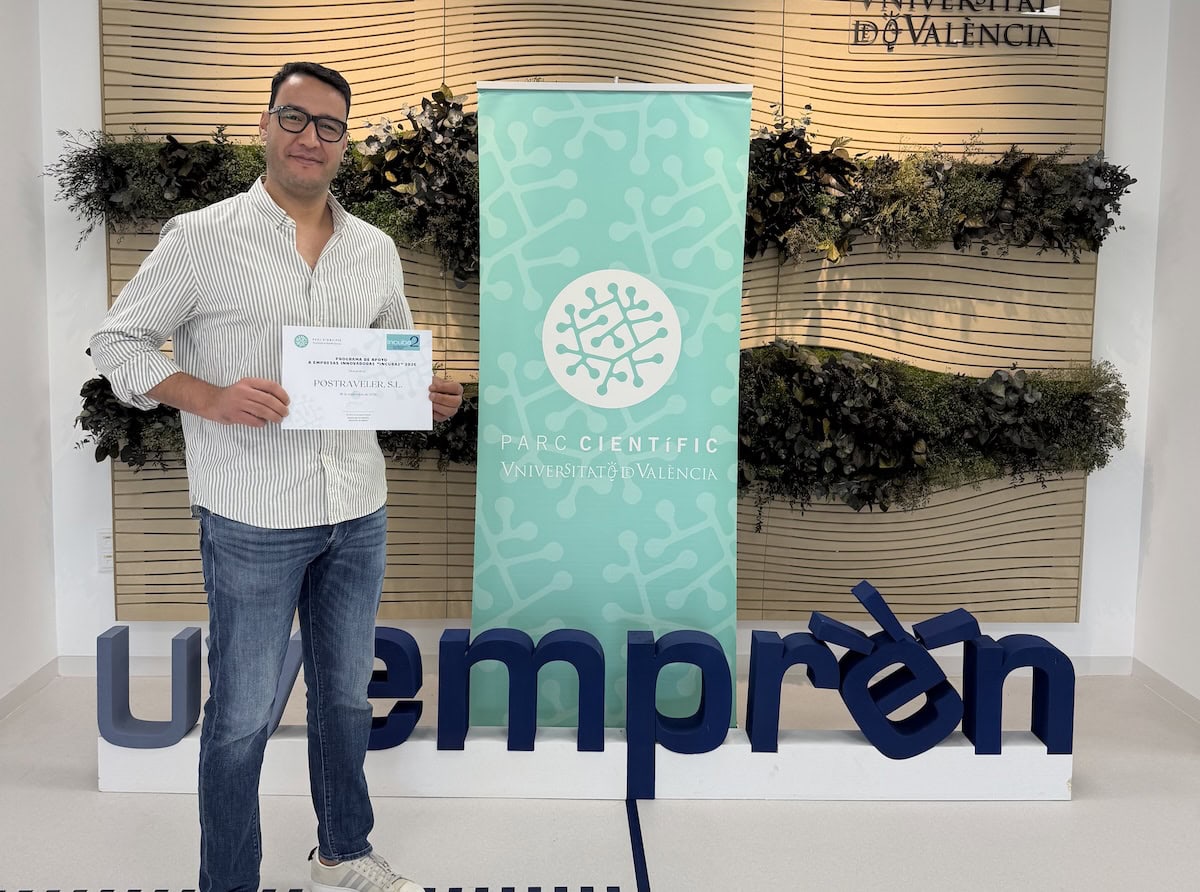
You are participating in the University of Valencia’s INCUBA2 programme. What support do you receive there, and how has the programme influenced the development of the company and the platform?
INCUBA2 gives us access to the entrepreneurial environment of the University of Valencia, workspace in its business incubator, mentoring sessions and connections within the innovation ecosystem. For a small team, that institutional framework is very valuable: we can discuss decisions with external experts, build relationships and work within a university environment. What matters most to us is that the programme supports us at a stage where we already have a real product and real users.
You have already presented YourPoste in a detailed interview on Medi1 TV Afrique. How important are public visibility, partnerships and personal networks when building the platform, and what challenges do you currently face as a small team?
For a marketplace, trust is essential, and credible public visibility helps build it. Media coverage, universities, partnerships and referrals can show users that there is a real company and an accessible team behind the app. At the same time, media visibility does not replace marketplace liquidity. Our current challenge is managing product, support, growth, partnerships, compliance and traveller acquisition at the same time with limited resources. That is why we are increasingly focusing on actions that directly increase density on our strongest routes.
What is your long-term vision for YourPoste, how do you want to develop the platform internationally, and what three pieces of advice would you give other founders turning an everyday personal problem into an international business?
Our long-term goal is to make YourPoste a reference platform for cross-border C2C logistics between international communities. We want to make a small number of corridors genuinely liquid first, and then replicate that model in additional countries. Trust, identity verification, insurance and a simple payment and delivery process should become increasingly integrated into the product.
My three pieces of advice would be: first, a personal problem can be a strong starting point, but you need to validate very quickly whether other people are actually willing to use a product to solve it. Second, in a marketplace, do not only count users; measure how quickly supply and demand actually match. Third, thinking internationally does not mean launching everywhere at the same time. It is often better to solve one specific market or corridor very well and turn that into a repeatable expansion model.
Photo credit: yourposte.com
Thank you Mohamed Arhoujdam for the Interview
Statements of the author and the interviewee do not necessarily represent the editors and the publisher opinion again.