

PatentDrawAI helps inventors streamline the invention process and navigate patent development through an AI powered platform designed to support innovation from idea to commercialization
What inspired the creation of PatentDrawAI, and how has the platform evolved since its founding?
As an inventor, I realized how difficult it was to claim ownership of an idea without sufficient resources. PatentDrawAI was created to address the complexity, cost, time, and knowledge barriers associated with traditional patenting and product development. The platform began as an AI-enabled system focused on patent search, drafting, and technical illustration, but it has evolved into what we describe as an invention operating system supporting the entire invention lifecycle from idea validation through product commercialization. This evolution reflects a growing demand for an end-to-end invention solution rather than isolated patent services.
Cory, how have your experiences in cybersecurity, artificial intelligence, and enterprise software engineering influenced the development of PatentDrawAI?
My background spans cybersecurity, AI, software engineering, and emerging technologies. As a technologist and engineer, I developed the skill set to understand how AI can solve the bottlenecks and complexities within the existing patent system. This led to the creation of a scalable, unified platform that serves as a system of record, enabling real-time claim verification and ownership tracking within an integrated solution.
PatentDrawAI aims to democratize the invention process. What barriers in the traditional intellectual property landscape are you trying to remove?
Traditional patenting can be expensive, time-consuming, and difficult to navigate without specialized legal and technical expertise. PatentDrawAI seeks to lower these barriers by automating patent searches, drafting, illustrations, and related workflows. The goal is to make innovation accessible to individual inventors, startups, researchers, and organizations that may not have large IP budgets or dedicated legal teams.
How does PatentDrawAI help inventors move from an initial idea to commercialization more efficiently than traditional approaches?
Rather than requiring inventors to coordinate with separate vendors for patent research, drafting, engineering support, visualization, and licensing, PatentDrawAI consolidates these functions into a single AI super application. This reduces friction, accelerates decision-making, and enables innovators to move from concept validation to market readiness with fewer handoffs and lower costs.
Who are your primary target users, and what specific challenges do inventors, startups, and enterprises bring to the platform?
Our platform serves several key user groups. Individual inventors seek affordable access to patent and product development resources. Startups need to validate ideas and attract investment. University students and tech transfer offices look for lower-cost alternatives to in-house legal solutions. Patent professionals want a unified platform instead of relying on multiple segmented tools. Enterprises aim to manage large IP portfolios, accelerate commercialization, and reduce costs. Each group faces distinct challenges, ranging from budget constraints and lack of expertise to portfolio management, competitive monitoring, and innovation scalability.
What makes PatentDrawAI unique in a market that already offers patent services, innovation tools, and AI-powered solutions?
Many existing solutions focus on a single problem, such as patent search, drafting, or legal workflow management. PatentDrawAI differentiates itself by connecting invention creation, intellectual property development, engineering support, technical visualization, and commercialization into one ecosystem. Our vision encompasses the full invention lifecycle rather than just patent services.
Real-time claim validation and ownership verification are key features of your platform. Why are these capabilities so important for modern innovators?
Innovation moves quickly, and inventors increasingly need confidence that their ideas are novel, defensible, and properly documented. Real-time validation helps identify potential conflicts early, while ownership verification establishes provenance and credibility. These capabilities are especially valuable in a global, distributed environment where AI-assisted creation is becoming more common. For users who cannot afford to formally file through a patent office, our platform provides a system of record and offers a neutral third-party certificate of invention with a timestamp to verify ownership similar in concept to organizations like WIPO.
PatentDrawAI has gained traction in more than 90 countries. What does this global interest tell you about the current state of innovation and intellectual property?
Global adoption indicates that innovation is no longer concentrated in a few traditional technology hubs. Entrepreneurs, researchers, and inventors worldwide are seeking affordable tools to protect and commercialize their ideas. It also highlights the growing demand for AI-powered solutions that simplify access to intellectual property systems.
What have been the biggest challenges in building a platform that combines IP creation, product development, and commercialization in one ecosystem?
One of the main challenges is integrating disciplines that have traditionally operated independently. Patent law, engineering, market validation, product development, and licensing each involve distinct workflows and stakeholders. Building a platform that connects them while maintaining accuracy, usability, and reliability requires significant technical and organizational coordination.
As artificial intelligence continues to evolve, how do you see its role shaping the future of invention and intellectual property management?
AI is moving beyond frontier models into domain or industry-specific applications. It can accelerate prior art searches, drafting, market analysis, technical modeling, and commercialization planning. However, human expertise will remain essential for strategic decision-making, judgment, and assessing the broader impact of inventions. AI will augment innovators rather than replace them.
What are the next major milestones for PatentDrawAI, and what new developments can users expect in the coming years?
Based on our current trajectory, key priorities include expanding AI-assisted invention workflows, strengthening commercialization and licensing tools, enhancing enterprise portfolio management, and advancing engineering and visualization capabilities. These developments will further position PatentDrawAI as a comprehensive innovation platform rather than solely a patent tool.
Looking back on your entrepreneurial journey, what three pieces of advice would you give to founders who want to turn innovative ideas into successful businesses?
First, solve a problem you have personally experienced; focus on a genuine pain point rather than a technology in search of a use case.
Second, build quickly and learn continuously. While planning is important, getting a product into the market and gathering real customer feedback is far more valuable. That feedback will provide insights you could not have anticipated and help refine your product to meet real market needs.
Finally, don’t give up. You will encounter obstacles and criticism, but resilience and unwavering confidence are essential to push through the challenges of entrepreneurship.
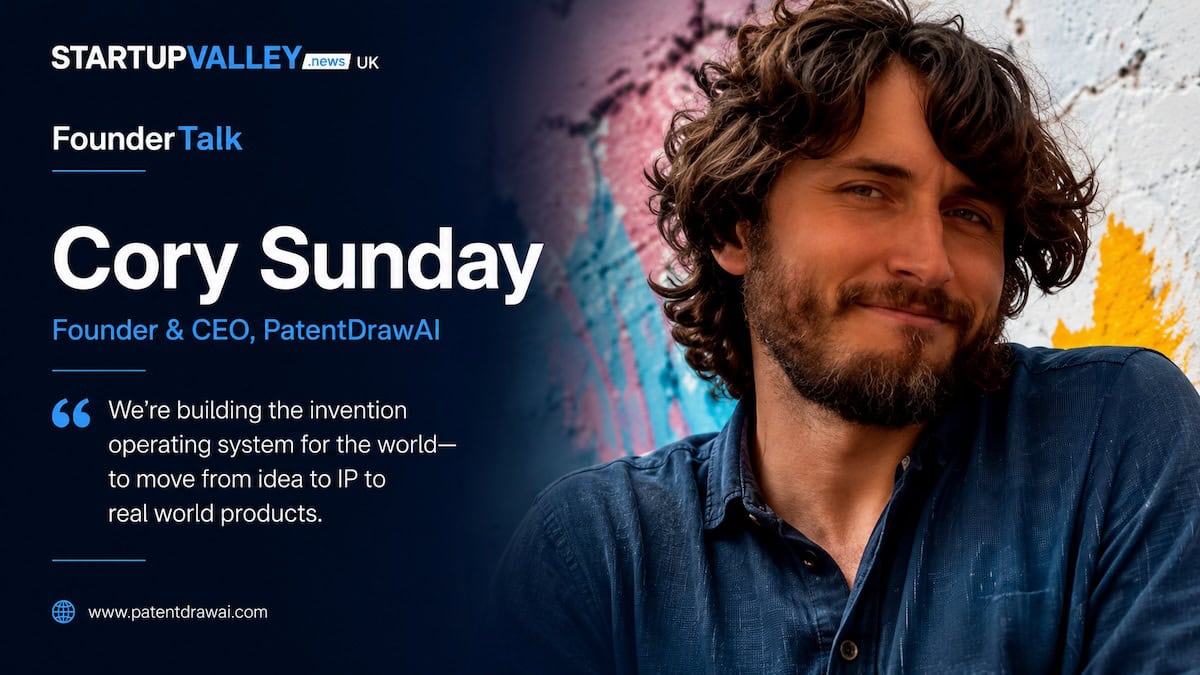
Picture: Cory Sunday PatentDrawAI
Thank you Cory Sunday for the Interview
Statements of the author and the interviewee do not necessarily represent the editors and the publisher opinion again.