


AVILOO develops independent solutions for electric vehicle battery testing and is advancing battery diagnostics with its Battery Warranty to increase trust in the used EV market
What was the founding insight behind AVILOO – what gap in the market did you see that others were missing?
The founding insight was a structurally broken used EV market: nobody could say, with any certainty, what state a battery was actually in. Dealers, buyers, insurers – everyone was relying on a dashboard readout generated by the car’s own system, with no independent way of verifying it.
We saw a market about to scale into the tens of millions of used EVs with zero independent infrastructure behind its most expensive component. Every other part of the used car industry has independent inspection – mileage, service history, mechanical condition. EVs had nothing equivalent for the battery. That gap was the founding insight.
You’ve built the world’s largest independent EV battery diagnostics database. What does that scale actually mean in practice – how many vehicles, how many data points?
Our database holds results from over one million real-world battery tests, and it grows every day – it’s the largest independent EV battery diagnostics dataset in the world. That scale means we’re not extrapolating from a handful of lab samples; we have enough data across nearly every model, age bracket and usage pattern to build genuine degradation curves rather than guesses.
In practice, when we test a five-year-old Model 3 or a two-year-old e-Golf, we can tell you exactly where that battery sits relative to thousands of comparable vehicles – and with the recently introduced AVILOO Battery Warranty, not just what it reads today, but whether it’s ageing normally, ahead of schedule, or better than expected.
How does AVILOO’s diagnostic technology work, and what makes your data more actionable than what an OEM or dealer might already have access to?
The AVILOO FLASH Test takes three minutes and measures real capacity against the vehicle’s original energy capacity. Crucially, it isn’t a readout of what the car’s battery management system reports – which is what all other battery analytics companies do – it’s an independent SoH calculation.
BMS data is self-reported, unverified and inconsistent across brands. Ours is benchmarked against our database of comparable vehicles. That benchmarking is one of the real differentiators: an independently calculated single State of Health number tells you a lot, but compared against thousands of same-model, same-age batteries, it tells you exactly where a vehicle stands – and whether the price on the windscreen reflects that reality.
Who are your primary customers – is it fleet operators, dealers, insurers, OEMs – and how has working with AVILOO changed the way they make decisions?
Our customers span the full remarketing chain – dealer groups like Hedin and Emil Frey, leasing companies such as Ayvens and Arval, auction platforms including BCA and Cox Automotive, and OEMs like Mercedes-Benz, Volvo, Hyundai, Porsche Holding and others who use AVILOO across their European dealership networks.
What’s changed for all of them is that battery health has moved from a soft assurance to a hard number in the pricing conversation. Vehicles with a verified AVILOO certificate command higher resale prices and spend less time on the lot, because buyers no longer have to price in uncertainty. It’s turned a guessing game into a data-backed negotiation – on both sides of the table. The AVILOO Battery Warranty comes on top, at no cost for dealers or consumers.
You recently launched a Battery Warranty product. What problem does that solve, and why was reinsurance backing the missing piece?
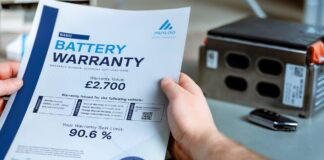
Before the warranty, an independent diagnosis gave you a snapshot – it told you the current state of the battery but offered no protection if it degraded faster than expected after purchase. Buyers had no financial recourse. The Battery Warranty closes that gap: if State of Health falls below a guaranteed minimum threshold within 12 months or 20,000 km, the owner is compensated with 3.000 EUR.
Reinsurance was the missing piece because without it, this is just a promise. With it, it’s a contractual, financially backed guarantee underwritten by AVILOO. That’s what turns a diagnostic certificate into real protection at the point of sale – and what makes a buyer willing to pay a premium for a verified vehicle rather than discount for the uncertainty.
What have been the hardest challenges in getting the industry to trust third-party battery data, and how have you overcome that scepticism?
The instinct in an industry built around manufacturer control is to treat the BMS as the single source of truth – and to be frankly suspicious of anything external that challenges it. We didn’t overcome that through persuasion; we overcame it through proof.
We had the methodology independently validated, and then we let the results speak. When Mercedes-Benz, Volvo, Hyundai, Porsche Holding and others adopted the FLASH Test across their own dealership networks – choosing an independent measurement over their own readout – that settled the debate more cleanly than anything we could have said ourselves. Premium OEMs don’t make those decisions lightly, and the rest of the industry noticed.
The used EV market is growing fast but consumer confidence around battery health remains a barrier. How significant is that problem, and how does AVILOO help solve it?
It’s the single biggest barrier to used EV adoption right now. The battery is the most expensive component in the car – often representing 40–50% of vehicle value – and at the point of purchase it’s still a black box for most buyers. Manufacturer State of Health figures aren’t independently verified, aren’t standardised across brands, and consumers know it. That uncertainty gets priced in as a discount, which suppresses the whole market.
Our own research shows over 90% of B2B buyers cite battery transparency as decisive in the purchase decision. AVILOO addresses this on two fronts: the FLASH Test delivers an objective, independently verified SoH calculation, and the Battery Warranty backs that with real financial protection if the battery doesn’t perform as certified. Together, they give buyers something to anchor their confidence on.
How has the industry – OEMs, dealers, insurers – responded to what AVILOO is doing, and where do you see the greatest urgency for wider adoption?
The response at the premium end has been decisive. When Mercedes-Benz, Volvo, Hyundai, Porsche Holding and others choose you as their preferred third-party testing provider across their European networks, that’s not a pilot programme — that’s infrastructure adoption.
The urgency for wider rollout sits further down the chain, with mid-market dealer groups and remarketing platforms where fleet and lease returns are landing at volume and the processes haven’t kept pace. That’s where the bulk of used EV transactions will happen over the next three to five years, and where the absence of independent battery data will create the most friction — for buyers, for lenders, and for the dealers trying to move stock efficiently.
What has been the defining milestone for AVILOO so far – the moment you knew the business had real traction?
The moment that confirmed we’d built something real was when Mercedes-Benz, Volvo, Hyundai, Porsche Holding and others came in as partners. Being chosen as an independent battery testing provider across their European dealership networks told us that diagnostics wasn’t a nice-to-have – it was infrastructure these companies were prepared to build into their own standard processes.
Crossing one million real-world tests around the same period gave us something equally important: the statistical depth to back that trust with genuine confidence. Together, those two things confirmed we’d moved from a promising idea to real market infrastructure.
Where do you see battery diagnostics fitting into the broader EV ecosystem over the next five years – and what’s AVILOO’s role in shaping that?
Battery diagnostics will become as standard to the used EV transaction as mileage or service history is to a combustion car today – not a premium add-on, but expected infrastructure that dealers, lenders, insurers and platforms build their processes around.
What I expect to change is where the authoritative data comes from. The market will consolidate around independent, brand-neutral diagnostics rather than manufacturer-reported figures, because trust at scale has to be earned through transparency, not claimed through ownership. AVILOO’s role is to be that infrastructure layer – the diagnostic standard and dataset the whole ecosystem plugs into. We’re building the reliability layer the used EV market can’t function at scale without.
Picturecredits AVILOO
Thank you Marcus Berger for the Interview
Statements of the author and the interviewee do not necessarily represent the editors and the publisher opinion again.